The Sequential Learning Group
Research
Generating Regular Time Series from Irregular Data
Real-world time series are irregular: sensors fail, channels drop out, and clocks drift. Our line of work builds diffusion models that learn the clean, regularly-sampled distribution from corrupted observations alone.
Papers
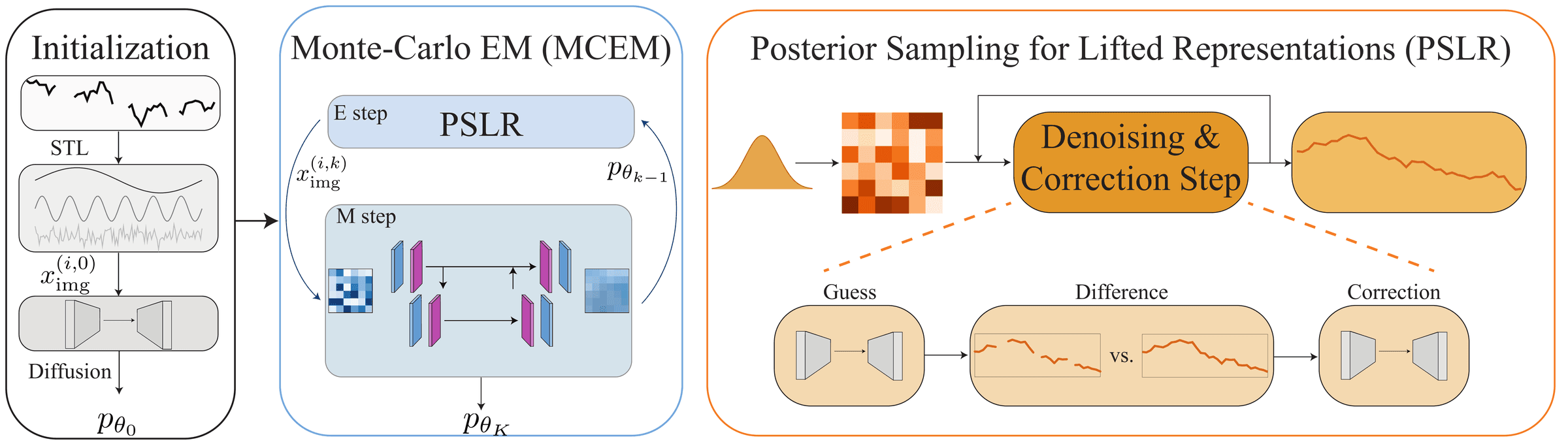
Closing the Loop: Co-Evolving EM for Irregular Time Series Generation in Lifted Representations
Gal Fadlon*, Idan Arbiv*, Omri Azencot
One-shot imputation is the bottleneck. We close the imputer–generator loop with a co-evolving Monte Carlo EM, and introduce PSLR, a posterior sampler for lifted (image) representations.
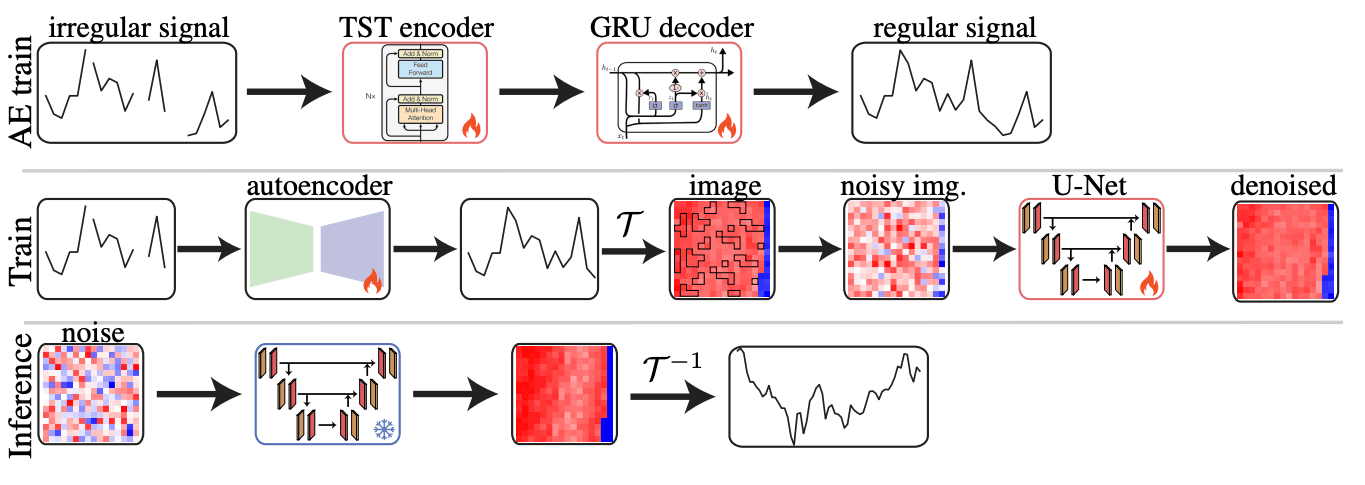
A Diffusion Model for Regular Time Series Generation from Irregular Data with Completion and Masking
Gal Fadlon*, Idan Arbiv*, Nimrod Berman, Omri Azencot
Complete irregular sequences with a Time Series Transformer, then train a vision diffusion model with masking, so completed values act only as weak conditioning.
How They Connect
- 2025
Complete once, then mask
ImagenI2R completes irregular series with a Time Series Transformer and trains a vision diffusion model with a masked loss, treating completions as weak conditioning.
Read more → - 2026
Close the imputer–generator loop
Closing the Loop shows that any one-shot imputer, including ours, is the bottleneck, and replaces it with a co-evolving EM that samples completions from the generator itself.
Read more →